Gentle Labeling: Not Everything Fits in a Box
Design
(
6
min read
)
(
)
How we name, frame, and sometimes fumble through complexity
Contributors
Ctrl+Z
Amy Nichanan
Share article
Share article
Functioning with Labelling
Labels are our first “technology” of understanding, a foundational cognitive shortcut. It enables humans to simplify complexity, communicate efficiently, and create systems of order. We use labels to sort, categorise, and navigate an impossibly complex world from nature to humans to man-made, everything in the world we can touch, feel and understand, or to live and work with.
By instinct, our brains love to label because it helps us make sense of a complex world quickly and efficiently. Labelling is one of the brain’s most basic cognitive shortcuts, an adaptive mechanism, simplified mental mode, memories that evolved unconsciously, habitually to reduce mental load and effort to “seek clarity”.
Ironically, labels help us navigate, but also trap us.
We label to know. But in labeling, we limit what can be known.
Labeling is never neutral. It frames perception, assigns value, and delimits possibility. A utility that comes at a cost: labeling flattens lived experience, often reinforcing stereotypes, binary thinking, and reductionist logic.
In our attempts to escape labels, over time, we often invent new ones, examples:
Minimalist aesthetics? Now a taste label.
Mental health diagnoses? Now social identities feel anchored.
Even the refusal to label, paradoxically, becomes a label in itself.
This is the paradox of labels, and the act of labeling often intensifies labeling in subtler, stickier forms.
We reduce ourselves into data to teach AI to know us.
AI inherits our ontologies (constructed realities), our biases, binary thinking, and label hunger, depending on labeled data to learn, but in labeling often simplifies what is deeply contextual or nuanced. In turn, it also produces hallucinations, not merely errors of outputs that are not grounded in reality, but at times distortions and recombinations of inherited frameworks—revealing the gaps between representation and reality.
May we find an alternative mode of perception, developing a new Future of Knowing (AI)?
This can also train AI to de-centre dominant perspectives, if we rethink the way we label and curate data. Or we may reprogram our way of seeing?
We don’t just need smarter machines. We need wiser metaphors for teaching AI and for understanding ourselves.
Can We Teach Machines to See Differently? We have officially passed the hype phases of AI and GenAI, and it’s never too late to take time to pause, pivot considering its rippling effects in a bigger sense.
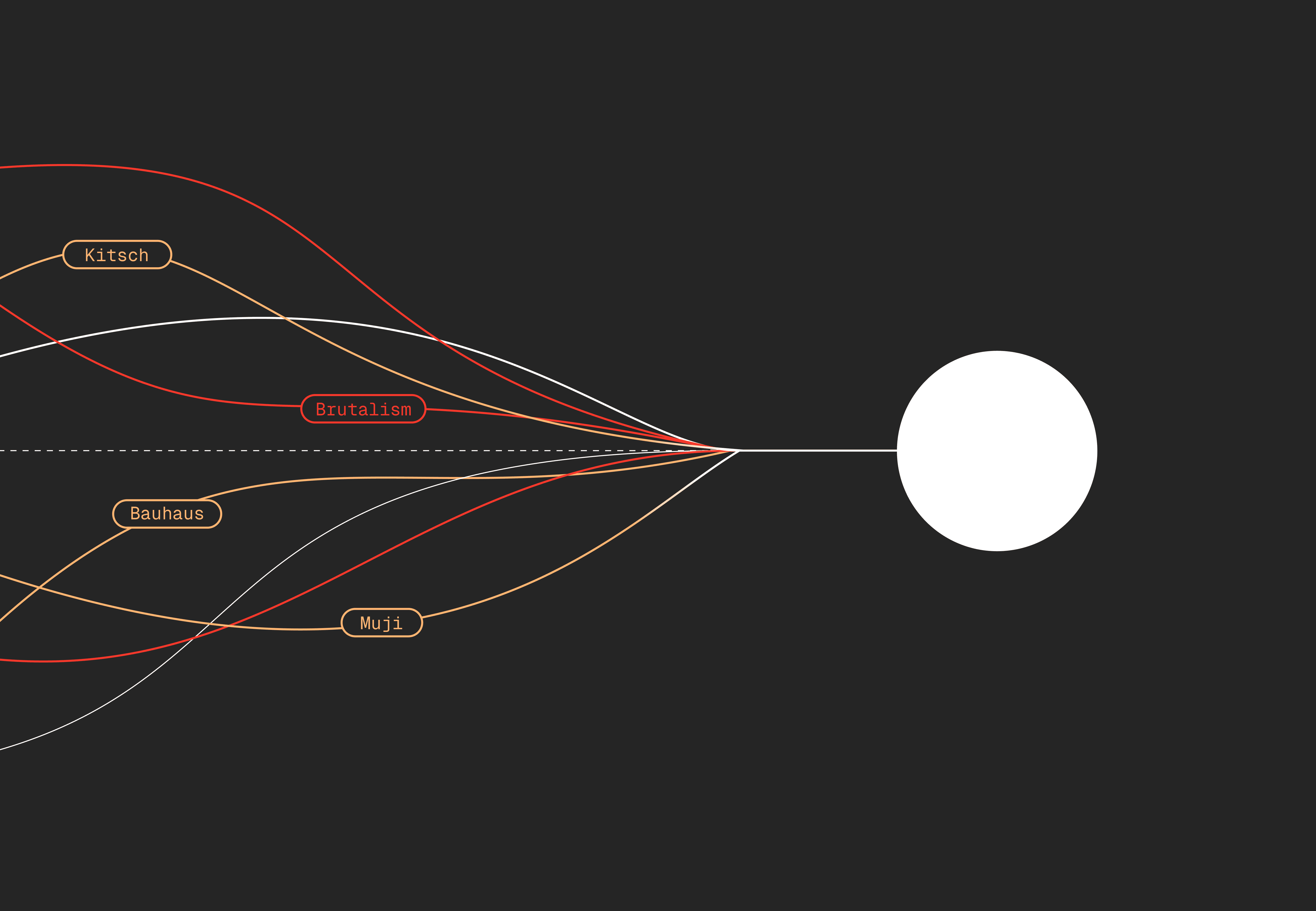
How may we progress with a Gentler Act of Labelling to honour our complexity, to move in the time and space of now and future?
I don’t have the answers now. This writing is to tickle our perceived intelligence.
To better illustrate the implications of labels, we reference two contrasting designs: Kitsch and Muji, and their respective aesthetics.
Theodor Adorno criticised kitsch as mass-produced culture that flattens meaning into shallow, easily consumable forms.
“Kitsch is beautiful without ugliness.” It offers immediate emotional gratification without tension or contradiction. A system that produces fixed, simplified meanings at scale. Relying on overused symbols and sentimental shortcuts, a hyper-labeled experience that assumes universal interpretation. It thrives on aesthetic predictability, requiring little engagement or thought. Creating labels that flatten meaning, and yet we still rely on them to navigate complexity.
Muji, on the other hand, exemplifies a post-label ethos. Its brand name literally means "no-brand quality goods" (Mujirushi Ryohin), and it emphasises simplicity, functionality, and silence.
Muji products resist the loudness of marketing language and reject overt labels or ornamental excess. They invite interpretation through use and relationship rather than dictating value through packaging or logos.
Kitsch
Muji
Sentimental, decorative excess
Functional minimalism
Mass symbolic appeal
Silent, context-driven aesthetics
Consumed passively
Interpreted through personal experience
Clings to fixed cultural signs
Rejects overt signifiers
Kitsch
Muji
Sentimental, decorative excess
Functional minimalism
Mass symbolic appeal
Silent, context-driven aesthetics
Consumed passively
Interpreted through personal experience
Clings to fixed cultural signs
Rejects overt signifiers
Ironically, the MUJI ethos has itself become a label, synonymous with minimalist sophistication and a lifestyle archetype embraced globally. The “no-brand” brand has accumulated symbolic capital, serving as a marker of taste, restraint, and a distinct Japanese sensibility. This paradox reveals the persistent gravitational pull of labels, even in attempts to move beyond them.
Rather than attempting to erase this contradiction, but to recognise it and remain attentive to its effects.
The aim is not to remove all forms of identification, but to stay consciously engaged with the meanings we construct. Brands such as MUJI can function as case studies in reflexive design, where transparency, intentionality, and impermanence are embedded within the system. We learn to hold meanings lightly, let them evolve, and resist calcification.
These paradoxes do not invalidate the post-label project but illuminate its complexity.
The goal is not to escape paradox, but to live more consciously within it. While traces of this reorientation are visible today, they often exist in tension with dominant systems that continue to favour fixed labels and simplification.
The inherent conflict in labeling extends into AI systems
Contemporary digital technologies operate through classification, predictive modelling, and identity tagging systems that fix meaning into discrete, machine-readable forms. Rather than refining these labels, we might instead question their necessity.
By breaking from entrenched patterns of classification, we open up new ways of understanding. A way that supports more adaptive and generative forms of creation. This, in turn, creates the possibility for new modes of knowing.
When labels harden into truths, the space of possible actions narrows, constraining how systems can adapt and how solutions can emerge.
This speculative inquiry is not a blueprint, but an invitation: to unlearn, to re-sense, and to reimagine what it means to know, to care, and to be. Exploring how a post-labelling paradigm (where understanding is relational, sensory, pattern-based, or narrative) could reshape our deeply embedded systems.
Functioning with Labelling
Labels are our first “technology” of understanding, a foundational cognitive shortcut. It enables humans to simplify complexity, communicate efficiently, and create systems of order. We use labels to sort, categorise, and navigate an impossibly complex world from nature to humans to man-made, everything in the world we can touch, feel and understand, or to live and work with.
By instinct, our brains love to label because it helps us make sense of a complex world quickly and efficiently. Labelling is one of the brain’s most basic cognitive shortcuts, an adaptive mechanism, simplified mental mode, memories that evolved unconsciously, habitually to reduce mental load and effort to “seek clarity”.
Ironically, labels help us navigate, but also trap us.
We label to know. But in labeling, we limit what can be known.
Labeling is never neutral. It frames perception, assigns value, and delimits possibility. A utility that comes at a cost: labeling flattens lived experience, often reinforcing stereotypes, binary thinking, and reductionist logic.
In our attempts to escape labels, over time, we often invent new ones, examples:
Minimalist aesthetics? Now a taste label.
Mental health diagnoses? Now social identities feel anchored.
Even the refusal to label, paradoxically, becomes a label in itself.
This is the paradox of labels, and the act of labeling often intensifies labeling in subtler, stickier forms.
We reduce ourselves into data to teach AI to know us.
AI inherits our ontologies (constructed realities), our biases, binary thinking, and label hunger, depending on labeled data to learn, but in labeling often simplifies what is deeply contextual or nuanced. In turn, it also produces hallucinations, not merely errors of outputs that are not grounded in reality, but at times distortions and recombinations of inherited frameworks—revealing the gaps between representation and reality.
May we find an alternative mode of perception, developing a new Future of Knowing (AI)?
This can also train AI to de-centre dominant perspectives, if we rethink the way we label and curate data. Or we may reprogram our way of seeing?
We don’t just need smarter machines. We need wiser metaphors for teaching AI and for understanding ourselves.
Can We Teach Machines to See Differently? We have officially passed the hype phases of AI and GenAI, and it’s never too late to take time to pause, pivot considering its rippling effects in a bigger sense.
How may we progress with a Gentler Act of Labelling to honour our complexity, to move in the time and space of now and future?
I don’t have the answers now. This writing is to tickle our perceived intelligence.
To better illustrate the implications of labels, we reference two contrasting designs: Kitsch and Muji, and their respective aesthetics.
Theodor Adorno criticised kitsch as mass-produced culture that flattens meaning into shallow, easily consumable forms.
“Kitsch is beautiful without ugliness.” It offers immediate emotional gratification without tension or contradiction. A system that produces fixed, simplified meanings at scale. Relying on overused symbols and sentimental shortcuts, a hyper-labeled experience that assumes universal interpretation. It thrives on aesthetic predictability, requiring little engagement or thought. Creating labels that flatten meaning, and yet we still rely on them to navigate complexity.
Muji, on the other hand, exemplifies a post-label ethos. Its brand name literally means "no-brand quality goods" (Mujirushi Ryohin), and it emphasises simplicity, functionality, and silence.
Muji products resist the loudness of marketing language and reject overt labels or ornamental excess. They invite interpretation through use and relationship rather than dictating value through packaging or logos.
Kitsch
Muji
Sentimental, decorative excess
Functional minimalism
Mass symbolic appeal
Silent, context-driven aesthetics
Consumed passively
Interpreted through personal experience
Clings to fixed cultural signs
Rejects overt signifiers
Ironically, the MUJI ethos has itself become a label, synonymous with minimalist sophistication and a lifestyle archetype embraced globally. The “no-brand” brand has accumulated symbolic capital, serving as a marker of taste, restraint, and a distinct Japanese sensibility. This paradox reveals the persistent gravitational pull of labels, even in attempts to move beyond them.
Rather than attempting to erase this contradiction, but to recognise it and remain attentive to its effects.
The aim is not to remove all forms of identification, but to stay consciously engaged with the meanings we construct. Brands such as MUJI can function as case studies in reflexive design, where transparency, intentionality, and impermanence are embedded within the system. We learn to hold meanings lightly, let them evolve, and resist calcification.
These paradoxes do not invalidate the post-label project but illuminate its complexity.
The goal is not to escape paradox, but to live more consciously within it. While traces of this reorientation are visible today, they often exist in tension with dominant systems that continue to favour fixed labels and simplification.
The inherent conflict in labeling extends into AI systems
Contemporary digital technologies operate through classification, predictive modelling, and identity tagging systems that fix meaning into discrete, machine-readable forms. Rather than refining these labels, we might instead question their necessity.
By breaking from entrenched patterns of classification, we open up new ways of understanding. A way that supports more adaptive and generative forms of creation. This, in turn, creates the possibility for new modes of knowing.
When labels harden into truths, the space of possible actions narrows, constraining how systems can adapt and how solutions can emerge.
This speculative inquiry is not a blueprint, but an invitation: to unlearn, to re-sense, and to reimagine what it means to know, to care, and to be. Exploring how a post-labelling paradigm (where understanding is relational, sensory, pattern-based, or narrative) could reshape our deeply embedded systems.